quinta-feira, 28 de janeiro de 2010

Narasimha Mangalam


Narasimha Mangalam
[Well being Stotra addressed to Lord Narasimha]
Translated by P. R. Ramachander

[This Mangala stotra is addressed to Narasimha, an incarnation of Lord Vishnu. These songs are recited after reciting prayers to the Lord or after performing worship. Wishing Mangalam means, wishing all that is good.]

Mangalam sthamba dimbhaya,
Mangalam mruthyu mruthyuve,
Mangalam Roudhra roopaya,
Narasimhaya Mangalam. 1

Mangalam to the one who was born from a pillar,
Mangalam to the lord of death to the lord of death,
Mangalam to him who is fierce looking,
Mangalam to the Lord who is lion man.

Hirani kasipum hathwa,
Daithyendram deva kandakam,
Jagat rakshana duryaya,
Jagat bheejaya Mangalam. 2

Mangalam to the seed of universe,
Who killed the Asura called Hiranya Kasipu,
Who was the lord of Rakshasas and killer of devas,
And the Lord who was interested in saving of the world.

Prahlada Sthuthi santhushta,
Prasanna nija moorthaye,
Varadabhaya hasthaya,
Varadaya cha Mangalam. 3

Mangalam to the giver of boons,
Who was happy with the prayer of Prahlada,
Who was really a God with pleasant mien,
And who shows protection and boons by his hands.

Karagrair vajra samsparsair,
Narair shathru dharine,
Theeshna damshtathanvaya,
Tharkshya vahaya Mangalam. 4

Mangalam to the one carried by Garuda,
Whose hands are as hard to touch like a diamond,
Who puts down the enemies of men,
And who has very sharp protruding teeth.

Nara kanteeravaakara vyakthaa,
Athyugra vibhoothaye,
Mrugendraya narendraya,
Daivathendraya Mangalam. 5

Mangalam to the Lord of Devas,
Who has the shape of the man and lion,
Who has fierce disposition,
And who is the lord of men and beasts.

Kireeta hara keyura,
Kundalalnkruthaya cha,
Koti Surya prakasaya,
Deva simhaya Mangalam. 6

Mangalam to the God lion,
Who decorates himself with,
Crown, garland, bracelet and ear studs,
And who had the brilliance of billon suns.

Triyugadhi triprushtaya,
Trigunaya trimurthaye,
Nara kesari roopaya,
Lakshmi lolaya Mangalam. 7

Mangalam to the lover of Lakshmi,
Who belongs to three ages,
Who has three type of back,
Who has three characteristics,
Who is the three Gods,
And who has a man lion form

Mathsya kachapa varaha,
Rama Vamana murthaye,
Ramakrishnathmane Boudha,
Kalki simhaya Mangalam. 8

Mangalam to the fish, turtle, boat.
Parasu Rama and Vamana incarnations,
Who is the soul of Rama and Krishna and Budha,
And Kalki as well as the lion.

Sarva bheejaya sathyaya,
SArvadheeshtana murthaye,
SArveswaraya Sarvasmai,
SAthwa simhaya Mangalam. 9

Mangalam to the lion of truth,
Who is the real root of everything,
Who can be approached by every one,
Who is god of all and himself is every one.

sábado, 2 de janeiro de 2010

Sri Madhurastakam

Krishna.


Text1
adharam madhuram vadanam madhuram
nayanam madhuram hasitam madhuram
hridayam madhuram gamanam madhuram
madhur-adipater akhilam madhuram


His lips are sweet, His face is sweet,
His eyes are sweet, His smile is sweet,
His loving heart is sweet, His gait (walk) is sweet,
Everything is completely sweet about the Lord of Sweetness.

Text2
vachanam madhuram charitam madhuram
vasanam madhuram valitam madhuram
chalitam madhuram bhramitam madhuram
madhur-adipater akhilam madhuram


His words are sweet, His character is sweet,
His dress (garment) is sweet, His posture is sweet,
His movements are sweet, His wandering (roaming) is sweet,
Everything is completely sweet about the Lord of Sweetness.

Text3
venur madhuro renur madhurah
panir madhurah padau madhurau
nrityam madhuram shakhyam madhuram
madhur-adipater akhilam madhuram


His flute-playing is sweet, His foot-dust is sweet,
His hands are sweet, His feet are sweet,
His dancing is sweet, His friendship is sweet,
Everything is completely sweet about the Lord of Sweetness.

Text4
gitam madhuram pitam madhuram
bhuktam madhuram suptam madhuram
rupam madhuram tilakam madhuram
madhur-adipater akhilam madhuram


His song is sweet, His drinking is sweet,
His eating is sweet, His sleeping is sweet,
His beautiful form is sweet, His Tilaka (mark on the forehead) is sweet,
Everything is completely sweet about the Lord of Sweetness.

Text5
karanam madhuram taranam madhuram
haranam madhuram ramanam madhuram
vamitam madhuram shamitam madhuram
madhur-adipater akhilam madhuram

His deeds (activities) are sweet, His conquest (liberating) is sweet,
His thieving (stealing) is sweet, His love-sports are sweet,
His oblations (offerings) are sweet, His countenance is sweet,
Everything is completely sweet about the Lord of Sweetness.

Text6
gunja madhura mala madhura
yamuna madhura vici madhura
salilam madhuram kamalam madhuram
madhur-adipater akhilam madhuram

His gunja-berry necklace is sweet, His flower garland is sweet,
sweet is the Yamuna river, and sweet are her rippling waves,
her water is sweet, and sweet are the lotus flowers also,
Everything is completely sweet about the Lord of Sweetness.

Text7
gopi madhura lila madhura
yuktam madhuram muktam madhuram
dhristam madhuram shistam madhuram
madhur-adipater akhilam madhuram

His gopis (cowherd girlfriends) are sweet, His pastimes (plays) are sweet,
His union (meeting him) is sweet, His deliverance (rescue) is sweet,
His sidelong glances are sweet, His courtesy (etiquette) is sweet,
Everything is completely sweet about the Lord of Sweetness.

Text8
gopa madhura gavo madhura
yastir madhura shristhir madhura
dalitam madhuram phalitam madhuram
madhur-adipater akhilam madhuram


His gopas (cowherd boyfriends) are sweet, His cows are sweet,
His cane (herding-stick) is sweet, His creation is sweet,
His victory (trampling) is sweet, His accomplishment (fruition) is sweet,
Everything is completely sweet about the Lord of Sweetness.


|| iti srimad vallabha-acarya viracitam madhurastakam sampurnam ||

|| Thus ends the the eight stanza hymn madhurastakam composed by Sripad Vallabha-acharya ||

quarta-feira, 16 de dezembro de 2009

Gayatri Mantra


O Gayatri Mantra é o mais venerado mantra no Hinduismo. Consiste no prefixo :oṃ bhūr bhuvaḥ svaḥ ॐभूर्भुवस्वः, uma fórmula tirada do Yajurveda, e o verso 3.62.10 do Rig Veda (que é um exemplo da métrica Gayatri). Porque todos os outros três Vedas contêm muito material reorganizado do Rig Veda, o Gayatri mantra é encontrado em todos os quatro Vedas. O deva invocado neste mantra é Savita, e conseqüentemente o mantra também é chamado de Sāvitrī.

Amplamente aclamado na Índia e por hindus, a posição suprema do Gāyatrī Mantra é mais adiante aumentada pela proclamação do Senhor Krishna no seu discurso espiritual, o Bhagavad Gita, que entre os mantras ele é o Gāyatrī. O Gayatri Mantra é proclamado no Gita como a Oração Universal, sem consideração de casta, credo ou sexo. É uma oração com o propósito de proteger qualquer indivíduo, e, quando expressado com imensa devoção e concentração, vai proteger a pessoa. Contudo, uma pronúncia adequada é necessária e espera-se que a pessoa seja um vegetariano rígido.

ॐ भूर्भुवस्वः ।
तत् सवितुर्वरेण्यं ।
भर्गो देवस्य धीमहि ।
धियो यो नः प्रचोदयात् ॥
Om bhūr bhuvar svar

tat savitur varenyam

bhargo devasya dhīmahi

dhiyo yo nah prachodayāt
"Que nós possamos atingir aquela excelente glória de Savitr :(c) "Para que, assim, ele possa estimular as nossas orações."
Explicação palavra-por-palavra (palavras não estão na ordem exata):-

om O som sagrado, ver Om.
bhū 'terra'
bhuvas 'atmosfera'
svar 'luz, céu, espaço'
dhīmahi 'Que nós possamos atingir' (1a pessoa plural médio optativo de dhā- 'Pôr, trazer, fixar' etc.)
tat vareṇyam bhargas 'aquela excelente glória' (acusativos de tad (pronome), varenya- 'desejável, excelente' e bhargas- 'radiância, lustre, esplendor, glória')
savitur devasya 'de Savitr o Deus' (genitivos de savitr-, 'estimulante; nome de uma deidade solar' e deva- 'deus' ou 'demi-deus')
yaḥ pracodayāt 'que possa estimular' (nominativo singular do pronome relativo yad-; causativo 3a pessoa de pra-cud- 'colocar em movimento, apressar, persuadir, impelir, impulsionar')
dhiyaḥ naḥ 'nossas orações' (plural acusativo de dhi- 'pensamento, meditação, devoção, oração' e naḥ enclítico pronome pessoal

Originalmente a personificação do mantra, a deusa Gayatri é considerada veda mata, a mãe de todos os Vedas e a cônjugue do deus Brahma, e também a personificação do onipenetrante Parabrahman, a realidade imutável que está por trás de todos os fenômenos.

Gayatri é geralmente retratada sentada num lótus vermelho, significando riqueza. Ela aparece em qualquer uma dessas formas:

Como tendo cinco cabeças, com dez olhos olhando nas oito direções e o céu e a terra, e dez braços segurando todas as armas de Vishnu, simbolizando todas as suas reencarnações.
Acompanhada por um cisne, segurando um livro em uma mão, e uma cura na outra, como a deusa da Educação.

sábado, 12 de dezembro de 2009

Hari Namashtakam


[Octet on Lord Hari]
Translated by P. R. Ramachander

Sri Kesavachyutha mukunda Radangapane,
Govinda, madhava Janardhana dhanavare,
Narayanamarapathe, srijagannivasa,
Jihve japethi sathatham Maduraksharani. 1

Hey toungue, always repeat the sweet letters,
Kesava*, Achyutha, Mukunda, He who holds the wheel,
Govinda, Madhava, Janardhana, killer of asuras,
Narayana, lord of devas, and he who lives all over the universe.
* For meaning of these names look in Vishnu Sahasranama translation.

Sri deva deva, madhusudhana, saranga pane,
Damodhararnva nikethana, Kaida bhaare,
Viswambharabharana bhooshitha bhumipala,
Jihve japethi sathatham Maduraksharani. 2

Hey toungue, always repeat the sweet letters,
Lord of lords, killer of Madhu, He holds Saranga,
Damodhara, he who sleeps on the sea, enemy of Kaidabha,
He who dresses with universe and the king who is well ornamented.

Sri Padma lochana, gada dhara, Padmanabha,
Padmesha padma pada pavana, padma pane,
Peethambara ambara ruche ruchiravathara,
Jihve japethi sathatham Maduraksharani. 3

Hey toungue, always repeat the sweet letters,
He who has eyes like lotus, he who holds the mace,
He who has lotus on his belly, He who is the Lord of Lakshmi,
He who has soft feet like the lotus, he who holds a lotus,
He who wears yellow silk, he who wears the sky and
He who has very interesting incarnations.

Srikantha kousthubha dhararthi harabjapane,
Vishno, Trivikrama, maheedhara, dharma setho,
Vaikunta vasa, vasudhadhipa, Vasudeva,
Jihve japethi sathatham Maduraksharani. 4

Hey toungue, always repeat the sweet letters,
Consort of Sri, holder of Kousthubha, killer of troubles,
Holder of lotus flower, Vishnu, Trivikrama, lifter of earth,
Bridge to Dharma, He who lives in Vaikunta,
King of the earth, Son of Vasudeva.

Sri Narasimha Narakanthaka, kanthamurthe,
Lakshmipathe, garudavahana, sesha sayin,
Kesi pranasana, sukesi kireeta moule,
Jihve japethi sathatham Maduraksharani. 5

Hey toungue, always repeat the sweet letters,
Narasimha, killer of hell, loved God,
Lord of Lakshmi, rider of eagle, he who sleeps on Sesha,
Stealer of life of Kesi and Leader of those praised by women.

Sri vathsa lanchana, surarshabha shankapane,
Kalpantha varidhi vihara hare murare,
Yagnesa yagnamaya yagnabhugadhi deva,
Jihve japethi sathatham Maduraksharani. 6

Hey toungue, always repeat the sweet letters,
He who has the mark of Sri Vathsa and lord of the devas holding a conch,
He who is the Vishnu who killed Mura and he who would play in the water at deluge,
He Who is the god of Yagna* and is full of yagna and is the primeval God who enjoys Yagna.
* Fire sacrifice.

Sri Rama ravana ripo,raghu vamsa ketho,
Sithapathe, dasaradathmaja, Rajasimha,
Sugreevamithra mruga vedhana chapa bane,
Jihve japethi sathatham Maduraksharani. 7

Hey toungue, always repeat the sweet letters,
Rama who is the enemy of Ravana, the star of the clan of Raghu,
Lord of Sita, son of Dasaratha, lion among kings,

Sri Krishna vrushnivara yadhava radhikesa,
Govardhanodharana kamsa vinasa soure,
Gopala venu dhara pandu suthaika bandho,
Jihve japethi sathatham Maduraksharani. 8

Hey toungue, always repeat the sweet letters,
Krishna, the blessing of Vrushni clan, cowherd, lord of Radha,
He who lifted Govardhana, He who killed Kamsa,
Gopala, He who holds the flute and friend of the sons of Pandu.

Ithyashtakam Bhagavatha sathatham naro yo,
Namangitham patathi nithya mananya chetha,
Vishno param padamupaithi punarna jathu,
Mathu payodhara rasam pibadeeha sathyam. 9

That man who reads this octet of the names,
Of God daily with mind focused on reading,
Would attain the ultimate place of Vishnu,
And would truly never, ever drink mother’s milk.

sexta-feira, 11 de dezembro de 2009

Mantra do Amor Divino

,santo nome.


A água, o ar e praticamente tudo hoje em dia está poluído.
Assim como os oceanos estão poluídos por veneno,prejudicando os peixes e os que consomen os peixes,a vibração sonora material também polui e envenena a atmosfera.As pessoas espalham venenos para matar insetos,envenenando os grãos e aquele que os comem.Similarmente,a vibração sonora material na forma de ofensas,críticas aos outros,discussões e assim por diante,e de fato,qualquer vibração material,polui as mentes,sentidos e corações por todo o mundo.Nós podemos neutralizar esta poluição e dor cantando o mantra Hare Krishna.
Podemos dar o exemplo de um grande lago.Se jogarmos uma pedra em suas águas,as ondas criadas tocarão todas as margens do lago.Este universo é assim também.O cantar de Hare Krishna Hare Krishna Krishna Krishna Hare Hare Hare Rama Hare Rama Rama Rama Hare Hare cria muitas ondas de vibração espiritual.Tais ondas alcançam tudo-até o fim do mundo-movem-se daqui para ali e purificam o universo inteiro de toda a poluição.
O Senhor Krishna é inconsebívelmente poderoso.Ele pode criar o universo inteiro em um segundo e então destruí-lo, e novamente é capaz de criar outros universos.Ele investiu toda Sua misericórdia,poder e opulência em Seus Nomese, portanto,estes também são ilimitadamente poderosos.Eles movem-se rapidamente através do universo como vibrações sonoras espirituais e a poluição gradualmente desaparece.
Árvores,trepadeirars,animais e insetos não podem falar(não como nós),eles não entendem nossa linguagem;ainda assim todas as criaturas em todo o universo,não apenas seres humanos,serão tocadas poderoso santo nome,estejam conscientes ou não disto.Se uma pessoa toca o fogo consciente ou inconscientemente sentirá seus efeitos,simirlamnete,estes santos nomes irão inspirar e purificar todas as entidades vivas,de forma consciente ou não.
Árvores ,gramíneas e seres humanos,todos se tornam afortunados quando ouvem sobre Krishna,e mesmo os seres das florestas serão gradualmente liberados do sofrimento.
Se cantarmos em voz alta,todos os nossos sentidos serão purificados e não haverá nada a ser criticado e nem memórias infelizes.Através de esforços materiais não podemos controlar os pensamentos tristes e maléficos que entram em nossas mentes,mas eles são conquistados muito facilmente pelo cantar.
Nossos corações serão gradualmente purificados por este cantar e então realizaremos que nosso verdadeiro interesse pessoal-a Alma de nossas almas-é o Senhor Krishna.
Portanto,se O servirmos,seremos beneficiados e o mundo inteiro também será.

‘’Deus é Amor e Amor é Deus
Cante Hare Krishna e seja Feliz!’’
(extraído do livro O caminho do Amor de Sua Divina Graça
Sríla Bhaktivedanta Narayana Gosvamí Maharaj-págs 28 e 29).

sexta-feira, 27 de novembro de 2009

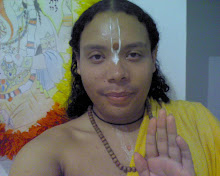
Tilak


A Hindu Primer
by

Shukavak N. Dasa

Copyright © 2007 Sanskrit Religions Institute
All rights reserved.

Religious Marks: Tilaka/Tika


Going hand in hand with religious denomination (sampradaya) are the religious marks worn by the devotees of the the various schools of Hindu theology. These marks are called tilaka, or in Hindi and many other regional languages, tika. The tilaka is a religious mark worn mainly on the forehead and is made primarily of sandal paste, clay, or ash. The word tilaka is literally a “freckle” or “spot” and it is considered highly auspicious to wear these marks. In general, there are three broad categories of tilaka marks, those worn by Vaishnavas, those worn by Shaivas and general marks. Tilaka marks are made with white, red, yellow or black colors. Vaishnava marks run vertically on the body and Shaiva marks run horizontally. The Vaishnava tilaka is the most extensive. A trained observer can tell exactly which school of theology a devotee is coming from by the color and shape of these tilaka marks. It is fun to visit a traditional holy place of pilgrimage during festival season to watch the holy men and try to read their tilaka and determine which sampradaya they are representing.

Shaiva Marks


Shaiva Tilaka
In general Shaiva tilaka is made of ash coming from burned wood, cow dung or incense. The tradition of ash goes back to stories that tell how Shiva would smear his body with ash taken from cremation sites, and so today, Shaivas mark their bodies with holy ash. In general, amongst Shaivas, the wearing of tilaka is not as extensive or as rigid as it is in the Vaishnava schools. Here are the most common Shaiva patterns. See the illustrations.

Vaishnava Marks


Shri Vaishnava Tilaka
By far the Vaishnava tilaka is the most extensive. Each school of theology, including all the sub-sects, have their own configurations. See the illustrations. In the modern world the wearing of tilaka was two functions, general religious identification and personal sanctification. Nowadays, the need to distinguish sectarian differences is no longer relevant. Amongst the Vaishnavas there was a time when it was considered “sinful” to wear Shaiva tilaka or to even see it. In the past the different schools of theology aggressively debated with each other over the correctness of doctrine and so, like a sports team today, the tilaka was used to identify which school the debater was representing. At one time Madhva Vaishnavas were antagonistic toward Advaita Vedanta Shaivas. Shaiva kings hunted down and even persecuted Shri Vaishnavas. Shaivas would not enter Vaishnava temples and Vaishnavas would not go near Shaiva shrines. But today such sectarian differences hardly exist, and so we see both Shaiva and Vaishnava shrines within the same temple. The function of tilaka has changed greatly. In the West only priests generally wear tilaka and consequently the main function of tilaka is to distinguish a priest from the lay community. This function is similar to how a male Christian priest may wear a collar to distinguish himself from his congregation.


The other function of tilaka is for personal sanctification. Tilaka is generally applied to the body in twelve places (the number varies) after bathing. These places include the forehead, the throat, the heart, the stomach, two shoulders, arms, and so on. Each time a mark is applied, the name of a particular Deity is recited. This touching, marking, and evocation has the effect of personal sanctification. A priest is dedicating his body as a temple of God by applying tilaka.

General Tilaka

Apart from the formal tilaka worn by priests, during a puja generally a simple form of tilaka will be applied to all lay members. This is the application of the so-called "dot" or red mark that is applied during puja or when attending temple. We often explain this by saying that God has given us two eyes for seeing the physical world, the red dot tika is a symbolic third eye or soul’s eye for seeing spiritual reality. During puja someone will often go around amongst the participants and give them tika. This function is akin to “logging in” to the puja, in other words, marking oneself as a faithful participant in the puja.

Krishna nos providencia um Guru


Krishna nos providencia um guru

Quando uma pessoa se rende sinceramente,sem sem o desejo de ganho material,Krishna providencia um guru.Por isso devemos chegar a este estágio e então poderemos facilmente receber a misericórdia rara deste gurur.Tudo depende de Krishna.
Um guru fidedigno é muito raro neste mundo e as escrituras explicam que um discípulo fidedigno que se rende completamente é ainda mais raro.Nós ouvimos sobre a rendição de Arjuna para com Krishna no Bhagavad gita. Os Vedas,Upanishads e Puranas citam muitos exemplos do guru ideal e do discípulo ideal,porém o exemplo mais exaltado é o de Srila Jiva Gosvamí e sua total rendição aos pés de lótus de Srí Rupa e Srí Srila Sanatana Gosvamis.
Agora podemos perguntar quem é o guru de Sríla Sanatana e Srila Rupa Gosvami?Sríla Rupa Gosvami orou para Srí Caitanya Mahaprabhu na sua invocação auspiciosa(mangalacarana),em cada um de seus livros.
Caitanya Mahaprabhu é a personalidade histórica que apareceu 500 anos atrás.No entanto nós compreendemos a partir da autoridade das escrituras que Ele é o próprio Sri Krishna,e que veio como Seu devoto para nos ensinar por meio de Seu exemplo como praticar o serviço devocional.Srí Rupa Gosvami e Srí Sanatana Gosvamí eram seus associados pessoais e discípulos diretos.Mas quando foi que Srí Caitanya Mahaprabhu iniciou Sri Rupa e Sri Sanatana?Ouvimos falar do sacrifício ser executado para a iniciação?E os mantras dados para eles? Não Srí Caitanya Mahaprabhu inculcou tudo em seus corações.Isto é mais importante,seguir Gurudeva interna e externamente.
Se oferecermos nossos corações naturalmente aos pés de lótus de um Vaishnava,ele será nosso guru,independente de ter sido executado ou não um sacrifício de fogo ou ele nos ter dado mantras.Estas são atividades externas e não são tão importantes quanto o processo interno de rendição do coração.
(extraído do livro:Controlado pelo Amor,de Sri Srimad Bhaktivedanta Narayana Maharaj,págs 18-19)